
Clutter
Making the invisible measurable.
Clutter is a neck assessment platform designed to measure head and neck movement and give clinicians clearer information to support decisions and track progress.
Clinical workflow
Clutter supports assessment and reassessment of head and neck function. Assistants can perform the assessments, while clinicians interpret the findings alongside clinical examination and reasoning to guide rehabilitation.
Editorial
The Dark Side of the Moon
The primary goal of virtual reality (VR) training for neck-injured people is to empower them to manage their own condition – guided by clinicians. Despite ever growing body of scientific knowledge, much of it remains confined to universities and is transferred into clinical practice only to a limited extent. This gap reflects the founder of Odin Neck Games experience from 40+ years of treating people with neck and back pain, combined with over 20+ years in academia.
Many factors contribute to this gap, but one of the most important is the low priority given to musculoskeletal disorders—especially uncomplicated neck pain—within modern medicine1. This is despite low back pain and neck pain ranking first and fourth worldwide, respectively, for years lived with disability (YLDs), according to the World Health Organization (WHO)2. More is spent on treating neck pain than on diabetes, ischemic heart disease, or fall3.
Odin Neck Games draws inspiration from Norse mythology and Nordic landscapes to deliver evidence-based virtual reality therapies for people with neck pain after injuries. Odin, the All-Father, returns from Valhalla to the origins described in Snorri Sturluson’s 13th-century Prose Edda4, accompanied by his legendary companions, symbolizing the fusion of ancient wisdom with modern rehabilitation.
Odin Neck Games is the first suite of serious virtual reality exergames to address all aspects of neck dysfunctions in a clinical setting. This science-backed approach combines entertainment and learning through animated, figurative, and metaphorical experiences that are accessible to people from diverse social, religious, and cultural backgrounds.
Clutter and Odin Neck Games align with the WHO’s Rehabilitation 2030: A Call for Action, which emphasizes accessible and effective rehabilitation5. WHO’s emphasis is drawn from the prior conclusions made by the Neck Pain Task Force (NPTF)6, an initiative established by WHO and the UN. Over a six-year period, the NPTF produced 23 articles that remain a leading source of evidence on WHY healthcare must shift direction for the growing population of people with neck pain. The NPTF identified recurrent episodes as one of the most defining characteristics of neck pain6, 7. This is consistent with the PAIN 50th Anniversary Supplement Editorial, which concludes that current rehabilitation for Neck Pain provides only modest short-term improvements in pain and disability8.
In practice, meaningful recovery is mostly limited to people with mild-moderate non-traumatic neck pain. Those with neck injuries and moderate to severe pain often continue to experience persistent pain and disability because the underlying biological, psychological, social, and pain-related factors are not adequately addressed. As the global burden of neck pain is projected to rise by about 32.5% between 2020 and 2050, more effective rehabilitation is urgently needed9.
This editorial presents the founder’s rationale and perspective on clinical practice. It does not report evidence of the effectiveness of Odin Neck Games or Clutter.
References
- Haldeman S (2011). Is it time to discard the term “diagnosis” when examining a person with uncomplicated axial neck pain? Commentary. The Spine Journal 11: 177–179.
- Institute for Health Metrics and Evaluation. https://www.healthdata.org
- Nguyen AT, Aris IM, Snyder BD, Harris MB, Kang JD, Murray M, Rodriguez EK, Nazarian A (2024). Musculoskeletal health: an ecological study assessing disease burden and research funding. Lancet Regional Health Americas 29:100661
- Sturluson, S (2005). The Prose Edda. Translated by Jesse Byock. Penguin Books. (Original work composed c. 1220)
- Briggs AM, Dreinhöfer KE (2017). Rehabilitation 2030: a call to action relevant to improving musculoskeletal health care globally. J Orthop Sports Phys Ther 47:297–300
- Guzman J, Hurwitz E, Carroll L, Haldeman S, Côté P, et al. (2008) Results of the Bone and Joint Decade 2000-2010 Task Force on Neck Pain and its Associated Disorders. Spine 33: 1-220.
- Kristjansson E (2020). Critical considerations about the onset and epidemiology of whiplash associated disorders presented by the bone and joint decade 2000-2010 task force on neck pain. Archives of Epidemiology and Public Health 1: 1–4. DOI: 10.15761/AEPH.1000115
- Cashin AG, Sterling M (2025). Optimising physical rehabilitation for people with musculoskeletal pain. PAIN 166:131–135.
- “GBD 2021 Neck Pain Collaborators,” (2024) Global, regional, and national burden of neck pain, 1990–2020, and projections to 2050: a systematic analysis of the Global Burden of Disease Study 2021. Lancet Rheumatology 6 (3); E142–E155. DOI: 10.1016/S2665-9913(23)00321-1
Eythor Birkir Kristjansson PT, PhD
Licensed Specialist in Musculoskeletal Therapy · Founder of Odin Neck Games
Vision
Vision Statement
Working towards a widespread use of both platforms to meet the underserved and growing population who have sustained head and neck injuries – meeting WHO’s and NPTF’s recommendations.
Mission
Mission Statement
To move from the commonly used label “non-specific neck pain” towards the label “specific neck pain” – a more precise and functional based understanding and approach of neck pain and its related disorders.
The term “non-specific neck pain” is used when X-rays, CT scans and MRI scans reveal no pathoanatomical findings, which can explain the patient’s symptoms and signs. Clutter aims to address this gap by combining scientifically grounded research, technical assessments, clinical examination – clinical reasoning of the invisible functional layer.
Peer to Peer
A message from the founder to fellow clinicians
My fellow clinicians:
Clutter + Odin includes a serious effort to map a new course through the cluttered landscape that people with head and neck injuries have faced for decades. Even dedicated clinicians can feel frustrated when treating people with recent symptoms or long-term effects of head and neck injuries. Clinicians know how difficult it can be to motivate patients to exercise, especially when they lack confidence in their own approach when treating people after head and neck injuries. This uncertainty can affect the head and neck-injured patients, leaving them feeling inadequately cared for.
Today’s technologies open a new era for clinicians to support effective, long-term recovery for people who have sustained head and neck injuries. VR has the potential to turn monotonous prescribed exercises into an immersive and engaging experience – bettering treatment adherence and therapeutic alliances. Besides, the blooming progress of artificial intelligence (AI) makes it possible to streamline personalized treatment more successfully, for the benefit of all stakeholders: the clinicians – the patients – the third-party payers.
Eythor Birkir Kristjansson PT, PhD · Specialist in MSK · Oslo, Norway
Clutter Test
New
Clutter Test
Clutter Test, the hallmark of Clutter Technical Assessment Platform, reveals detailed and hitherto occult motor control deficits in the neck. Due to the patent pending process, the new features measured in Clutter Test remain confidential.
References
A few prior art references inspiring the new art.
- Kristjansson E, Gislason MK. The Butterfly Method for Cervical Movement Sense: Construct Validity and Clinical Applicability. Austin Journal of Musculoskeletal Disorders. 2024; 1 (10): 1063–1070.
- Kristjansson E, Björnsdottir SV, Oddsdottir GL. The long-term course of deficit cervical kinaesthesia following a whiplash injury tends to seek a physiological homeostasis: An 8-year prospective study. Manual Therapy. 2016; 22: 196–201.
- Oddsdottir G, Kristjansson E, Gislason M. Database of movement control of the cervical spine: Reference normal of 182 asymptomatic people. Manual Therapy. 2013; 18: 206–210.
- Oddsdottir G, Kristjansson E. Two different courses of impaired cervical kinesthesia following a whiplash injury: A one-year prospective study. Manual Therapy. 2012; 17 (1): 60–65.
- Kristjansson E, Oddsdottir G. “The Fly” - A new clinical assessment and treatment method for deficits of movement control in the cervical spine: reliability and validity. Spine. 2010; 35: E1298–E1305.
- Kristjansson E, Treleaven J. Sensorimotor function and dizziness in neck pain: implications for assessment and management. Journal of Orthopaedic & Sports Physical Therapy. 2009; 39: 364–374.
- Kristjansson E. PhD Thesis: Investigations into the stability system of the cervical spine. Faculty of Medicine, University of Iceland in co-operation with University of Queensland, Brisbane, Australia. Defense date: 22 May 2004.
- Kristjansson E. The cervical spine and proprioception. Chapter 18 In: Grieve's Modern Manual Therapy of the Vertebral Column. Third Edition. Editors: Boyling/Jull. Churchill Livingstone, 2004.
- Kristjansson E, Hardardottir L, Asmundardottir M, Guðmundsson K. A new clinical test for cervicocephalic kinesthetic sensibility: “The Fly”. Archives of Physical Medicine and Rehabilitation. 2004; 85: 490–495.
- Kristjansson E, Dall'Alba P, Jull G. A study of five cervicocephalic relocation tests in three different subject groups. Clinical Rehabilitation. 2003; 17: 768–774.
- Kristjansson E, Dall'Alba P, Jull G. Cervicocephalic kinaesthesia: Reliability of a new test approach. Physiotherapy Research International. 2001; 6 (4): 224–235.

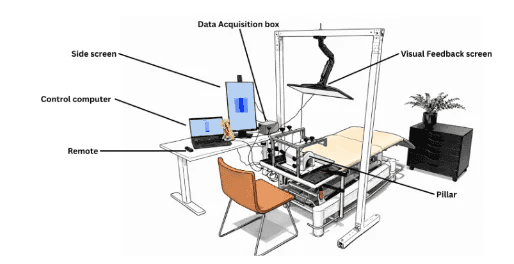
The setup is standardized. Before the Clutter Test, participants listen to a brief audio recording explaining the test procedures and what is required of them.
Revised–JPSE Test
New
Revised–JPSE Test
Compared with the conventional Joint Position Sense Error (JPSE) test, the revised version has stronger construct validity because it minimizes the influence of vestibular input and reduces reliance on memory. The test protocol also helps distinguish between healthy controls and people with non-traumatic versus trauma-induced neck pain.
This provides a more specific assessment of neck position sense – one aspect of cervical sensorimotor function. The test is performed in Clutter Platform and guides the Head-Neck Relocation Exercises at Mimir’s Well, located in the Norse universe.
The R-JPSE Test Protocol
- A research version with 6 repetitions in each of the 4 directions and a clinical version with 3 repetitions in each of the 4 directions
- The intermittent-reciprocal protocol is used
- The research version is also used when reporting to third-party payers
- The patient marks all events with a remote control
- The test is fast and easy to use
Deep Neck: Force Sense–Steadiness Tests
New
Deep Neck: Force Sense–Steadiness Tests
Highly accurate force sensors (+/- 0.0024%) respectively measure force sense and force steadiness in the deep muscles at the front and back of the neck.
The tests are being evaluated through supervised research projects, including a completed feasibility study. Studies of test–retest reliability and discriminant validity are planned. Together with previous research, these studies will provide the rationale for a new portable device designed to test and train the deep stabilizing muscles of the neck, both in isolation and in coactivation.
CROM
CROM Tests
The Cervical Range of Motion (CROM) Tests are divided into two categories:
- CROM - for the whole cervical spine.
- Flexion - Rotation Test for the upper cervical spine.
CROM Test Protocol
- CROM - for the whole cervical spine has a research version with 6 repetitions in each of the 4 directions and a clinical version with 3 repetitions in each of the 4 directions
- Flexion - Rotation Test has a research version with 6 repetitions in each of the 2 directions and a clinical version with 3 repetitions in each of the 2 directions
- The research versions are used when reporting to third-party payers
- The intermittent-reciprocal protocol is used
- The patient marks all events with a remote control
- The tests are fast and easy to use
Questionnaires
Pain & Disability Questionnaires
Twelve validated questionnaires are ready, each with its own outcome report, but they have not yet been integrated into the software. These patient-reported outcome measures (PROMs) establish each patient’s baseline and capture their experience of overall treatment results at regular intervals or at the end of rehabilitation. Some questionnaires screen for psychosocial yellow flags. When indicated, the results may support referral to a psychosocial care specialist.
Reports
New
Milestone Tracking Reports
- BASELINE
- CURRENT FUNCTIONAL PROFILE
- CHANGE OVER TIME
The clinician receives a baseline report and two concise summaries at each reassessment occasion during the rehab period: one describing the patient’s current functional profile and another showing changes over time. The clinician reviews each draft before implementation into the patient’s record.
Clinician reporting
A constrained large language model (LLM) produces a short draft based on verified scores, trends, and clinician-approved rules. The software calculates all numerical results in advance and links each statement to its source test and assessment session.
Gameplay and clinical data kept separate
Progress measured during exergaming is kept separate from independent clinical reassessments. Gameplay information is not combined with formal clinical evaluation, so progress can be assessed independently.
Constrained AI support
The initial AI package combines:
- Established scoring
- Generalized additive models (GAMs)
- Longitudinal statistical models
- A constrained large language model (LLM)
Sequence models may be added later. They are a possible future addition and are not part of the current functionality.
Validation should assess factual accuracy, important omissions, clinician time saved, and prediction performance where applicable. All AI algorithms must be validated using the platform’s own tests and patient data. Their outputs can feed a reporting system or language model that converts the results into readable text.
The models can identify associations but cannot establish the cause of a functional fault. They can determine whether a change exceeds measurement error when supported by adequate reliable evidence.
Clinician remains in control
- The software calculates the numerical results before drafting.
- Every statement links back to its source test and assessment session.
- Missing data is labeled “not assessed.”
- The LLM must not invent missing information.
- The clinician reviews and approves the draft before use.
- AI supports reporting and clinical interpretation. It does not independently make treatment decisions.
Patient-facing explanation
How we protect your data and track your recovery:
“To give you the best possible care, we use an advanced software assistant to help track your rehabilitation progress. When you perform your exercises and take your clinical tests, the software calculates your scores and helps your therapist write progress reports. To ensure accuracy, the system is kept on a very tight leash. It is only allowed to look at your actual test scores and is forbidden from guessing or making things up. If a test wasn’t completed, it simply marks it as ‘not taken.’ Most importantly, the computer never has the final say. Your clinician reviews, edits, and approves every single word before it ever becomes a part of your medical record. Furthermore, the fun data tracked while you play our exergames is kept completely separate from your official medical evaluations to ensure your progress is measured fairly and accurately.”
Selected references
- Collins et al. TRIPOD+AI. BMJ 2024;385:e078378. doi:10.1136/bmj-2023-078378.
- Clinical summary safety study: npj Digital Medicine 2025. doi:10.1038/s41746-025-01670-7.
Upcoming
Upcoming assessments
These offerings are upcoming and are not yet available.
Upcoming
Neuro-Oculomotor Assessment
Upcoming
Virtual Reality Posturography (VRP)
Upcoming
Neurocognitive Tests
Upcoming
Neuropsychological Questionnaires
Upcoming
New
Combined Test & Treatment Devices

The next step
Discuss Clutter in your clinical setting
Contact the team to discuss assessments, reassessments and potential clinical and research collaboration.